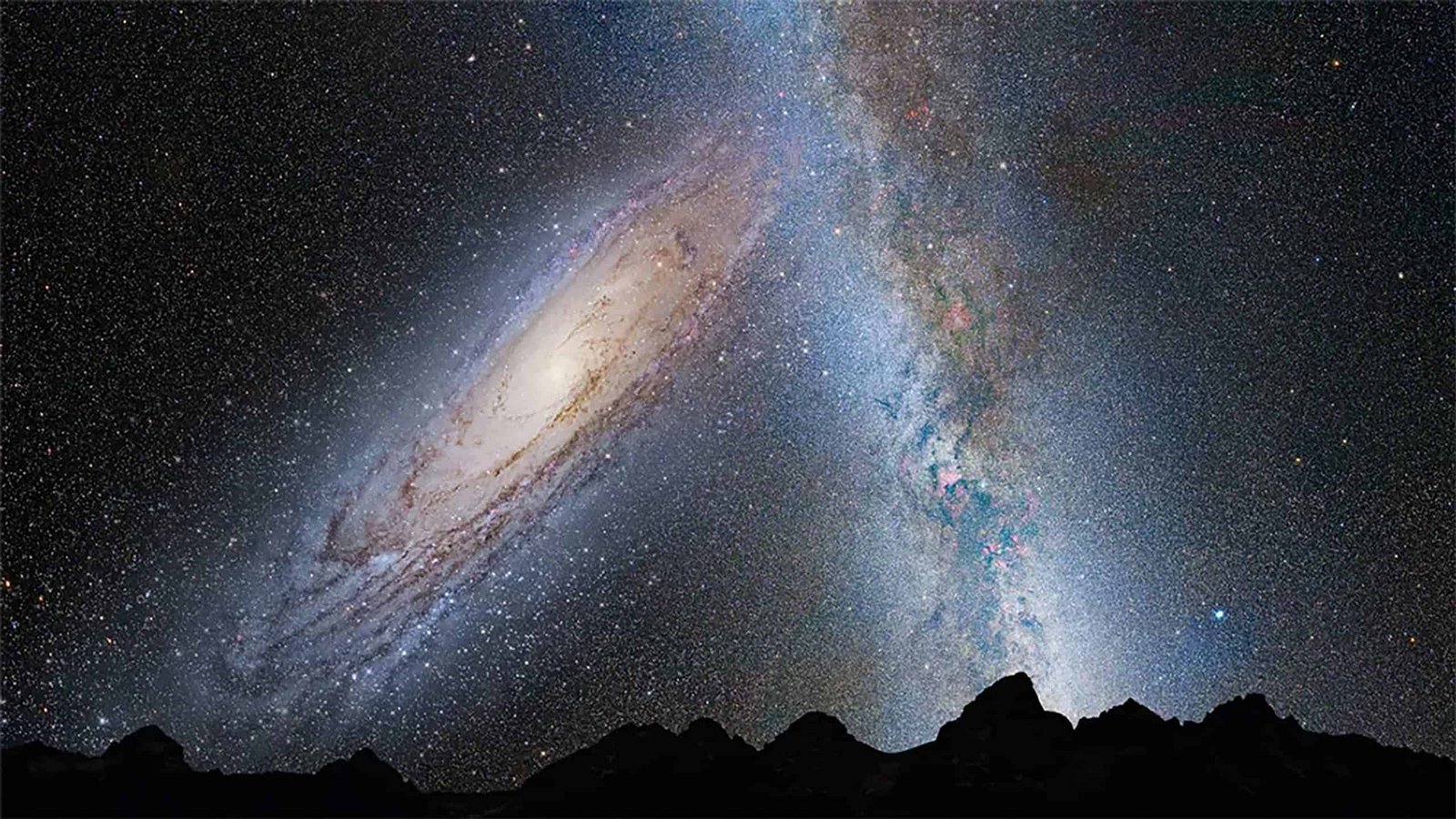
One of the most well -known events on the Milky Way is that it is on a collision route with its closest neighbor, the Andromeda galaxy. According to a study published last year, this shock should reconfigure the entire solar system.
But will this galactic fusion really happen? According to a survey published on Monday (2) in the magazine Astronomy of Nature The collision between the Milky Way and the Andromeda Galaxy may not be as safe as it was thought.
It was believed that the two galaxies, which are slowly approaching, would be shocking and fuse in about five billion years. This fusion would lead to a new galaxy, nicknamed “Milkomeda”. However, new data show that this forecast may have been hasty.

The destination of the Milky Way is on the “face or crown”
Scientists say that there is now only 50% chance that the milky and Andromeda road will be based on the next 10 billion years. That is, the possibilities are divided as in a boy or a crown. “It was amazing to find that the merger is so uncertain,” said Til Sawala, researcher at Helsinki University, Finland and the main author of the study. Space.com.
To reach this conclusion, researchers created simulations of the Milky Way movement for the next 10 billion years. They used more accurate data from the GAIA mission, made by the European Space Agency (ESA) and the Hubble Space Telescope (Partnership ESA/NASA). These simulations also considered the effect of smaller galaxies around us, which can influence their trajectory due to gravity.
One of the main news of the study was to include the great cloud of Magalhães, the largest satellite galaxy on the Milky Way. This celestial body exerts considerable force and can change the path of our galaxy. Previous studies did not take into account this factor, which makes this research more complete and updated.

Read -Ne More:
The model created by scientists presented several possible scenarios. In less than 2% of cases, there would be a direct frontal collision between the Milky Way and Andromeda. Most of the time, both would pass to each other, losing energy even, perhaps, fusing in the future. But if they do not reach less than 500,000 years of light, they may never join.
If the orbits are aligned and the gravity is strong enough, the fusion can happen naturally. But it is also almost equally likely that both follow separate paths, continuing to evolve independently in the universe. This would completely change the fate that scientists imagined.
On the other hand, the melting of the Milky Way with the large cloud of Magalhès seems inevitable. The study indicates that this meeting should take place in the 2.4 billion years. Researchers are now waiting for new data from Gaia and Hubble telescopes to better understand the cosmic future of our galaxy.