On Monday (26), NASA and Spacex agreed to an unprecedented contract for Elon Musk’s space company, for $ 256.6 million ($ 1.49 million R direct conversion).
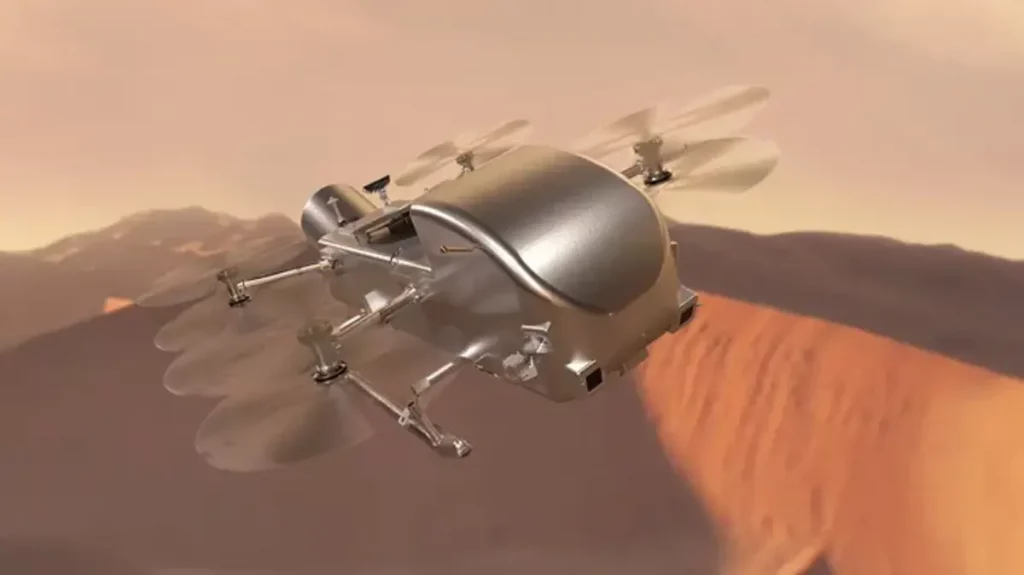
According to the information of ArstecnicThe contract provides for launching services and costs for the launch of Dragonfly’s helicopter, which will explore Titan, the largest Saturn moon.
Dragonfly is a source of energy a thermoelectric radioisotope generator (RTG). It generates energy from the heat emitted by the radioactive decomposition of plutonium-238. Therefore, it will be the first time that Spacex will bring nuclear materials to the space.

Spacex will bring nuclear materials to space
- This will be the first mission of Spacex, the source of energy that is nuclear instead of solar;
- Plutonian generators have been present in several previous NASA missions, such as perseverance, curiosity, new horizons and voyager;
- But all these missions were performed with retired or near rockets. Therefore, it is the time that NASA certifies a new generation of rockets to launch useful loads with a nuclear force;
- The United States Space Agency has already certified Spacex Rocket, Falcon Heavy, for more expensive robotic missions. However, to launch nuclear materials, there is a need for additional certification.
In this certification, there is a review of the security system of a range of explosive rockets to ensure that it does not damage its useful load and releases the radioactive plutonium.
Solar energy policy always (as possible)
NASA has a policy of always using solar energy to feed its space missions, at least whenever it gives it. Europe Clipper, for example, would originally use a nuclear energy generator, but the Mission Engineers team got the spacecraft to use expansive solar panels to receive solar energy and generate energy from it.
But there are missions, such as Dragonfly, where this is not possible. Spacex’s mission will plan Titan’s atmosphere, composed of nitrogen and methane. In addition, it is wrapped in dense clouds and is almost ten times farther from the Sun than the Earth, which makes its surface much darker.
The Spacex spacecraft will be launched with about 4.8 kg of plutoni-238 to supply its energy generator. This nuclear material is 88 years old and can safely feed the dragonfly for decades.
Read -Ne More:
Dragonfly will be launched encapsulated in a traffic module and an entrance capsule. Then he will descend from the parachute to the Titan atmosphere, four times denser than the Earth. It will then be separated from the descent module and will activate its eight rotors to safely land on the surface of the Moon.
When there is, the spacecraft will jump from one place to another flights, with the aim of exploring rich environments in organic molecules, called life building blocks.
But all this will still take some time, as the mission is scheduled to be launched in July 2028, with Dragonfly taking six years to reach Titan, so that only 2034 – ten years from now on.
Only this deadline was shorter. NASA selected Spacex for the project in 2019 and wanted to launch it by 2026.The space agency then asked him to conform to 2027 and then by 2028, so that Spacex operated on a large rocket.
And not only that: Dragonfly has suffered financial problems due to increasing its cost, all due to Covid-19 pandemic, which began by the beginning of 2020 and lasted until the middle of 2012.
Thus, the total cost of the mission has been more than twice the original value, reaching the amount of US $ 3.35 billion ($ 19.46 billion).