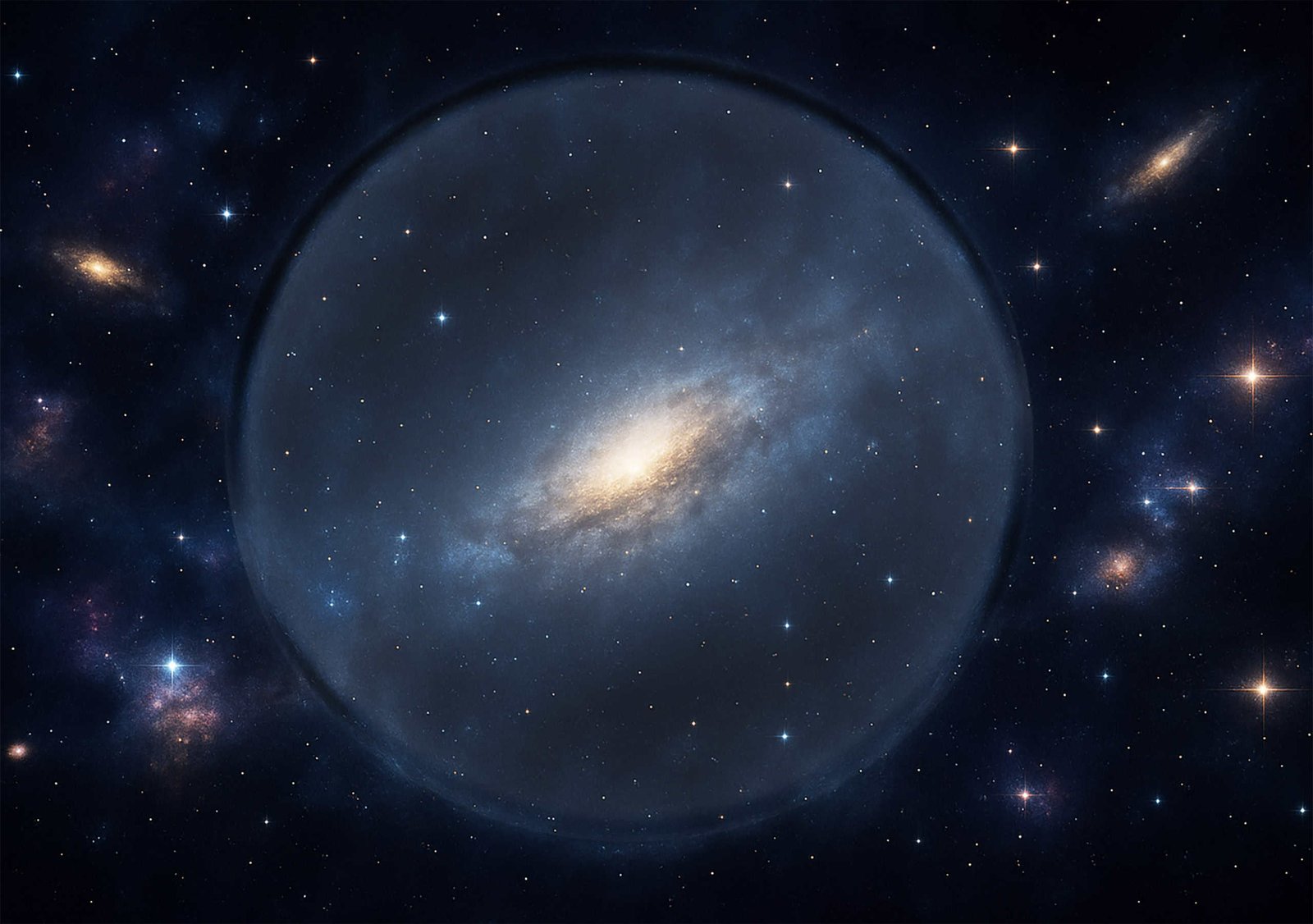
A study presented on Wednesday (9) during the National Astronomy Meeting (NAM) 2025, coordinated by the Royal Astronomical Society, in Durham, England, suggests that the Earth may be inside a giant cosmic gap, which would make the expansion of the universe look faster than in other regions.
The research is based on sound waves of the primitive universe – “the sound of the Big Bang”, according to a statement. These ancient echoes, preserved for billions of years, help to measure the expansion of space and to reveal standards that indicate something unusual in our cosmic neighborhood.
In a nutshell:
- The study suggests that the Earth is within a huge cosmic gap;
- This gap houses the entire Milky Way and gives the impression of a fastest expansion of the universe in this area;
- The hypothesis would resolve Hubble’s tension, which deals with the conflicting measures of cosmic expansion;
- “Big Bang Echoes” and less local galactic density reinforce the idea;
- Confirm the vacuum can change the known age and history of the universe.

Giant cosmic emptiness can explain the difference in the measures of the age of the universe
This proposal could explain the tension of Hubble, a name that gives the difference between two ways of measuring the expansion of the universe. The data obtained from distant galaxies indicates a slower pace, while the measures taken in nearby galaxies show faster expansion.
According to astronomer Indranil Banik of the University of Portsmouth, “a potential solution to this inconsistency is that our galaxy is near the center of a large local gap”, density about 20% below the average of the universe. This would make galaxies look away from us faster, giving the impression of accelerated expansion.
This gap would have about a billion years of light. The observations show that there are fewer galaxies in our region than in the neighboring areas, which supports the idea. However, the existence of such a large gap is still controversial because it does not fit well with the traditional model of cosmology.

The standard model provides for a more uniform distribution of matter to such large scales. However, new data strengthens the vacuum hypothesis. One of the main directions comes from baronic acoustic oscillations, standards formed by the sound waves of the primary universe.
These oscillations were frozen in space when the universe cooled and allowed the formation of the first atoms. As they function as fixed markers, they help astronomers measure the rhythm of cosmic expansion over time.
Read -Ne More:
Discovery can change the history of cosmos
When comparing these oscillations with the red deviation of galaxies light, which shows how the space expanded, researchers perceived a slight distortion caused by the possible presence of the vacuum. According to Banik, this model is tens of millions of times more compatible with the data than the model adopted by the Planck satellite, called “Homogeneous Planck Cosmology”.

In addition to explaining Hubble’s tension, discovery can also help confirm the true age of the universe, currently estimated at about 13.8 billion years. As the differences in the measurements generate uncertainties, if the vacuum is confirmed, there may be a new base for calculation.
The next step is to compare this model with other methods, such as cosmic chronicles, which study ancient galaxies that have stopped forming stars. The light issued by these galaxies helps to estimate the age of the stars present and cross this data with the deviation to red, showing the amount of expanded space.
If the results continue to indicate that something unusual in this region happens, the theory of “cosmic emptiness” can gain strength, forcing scientists to rethink everything that is understood today on the universe.