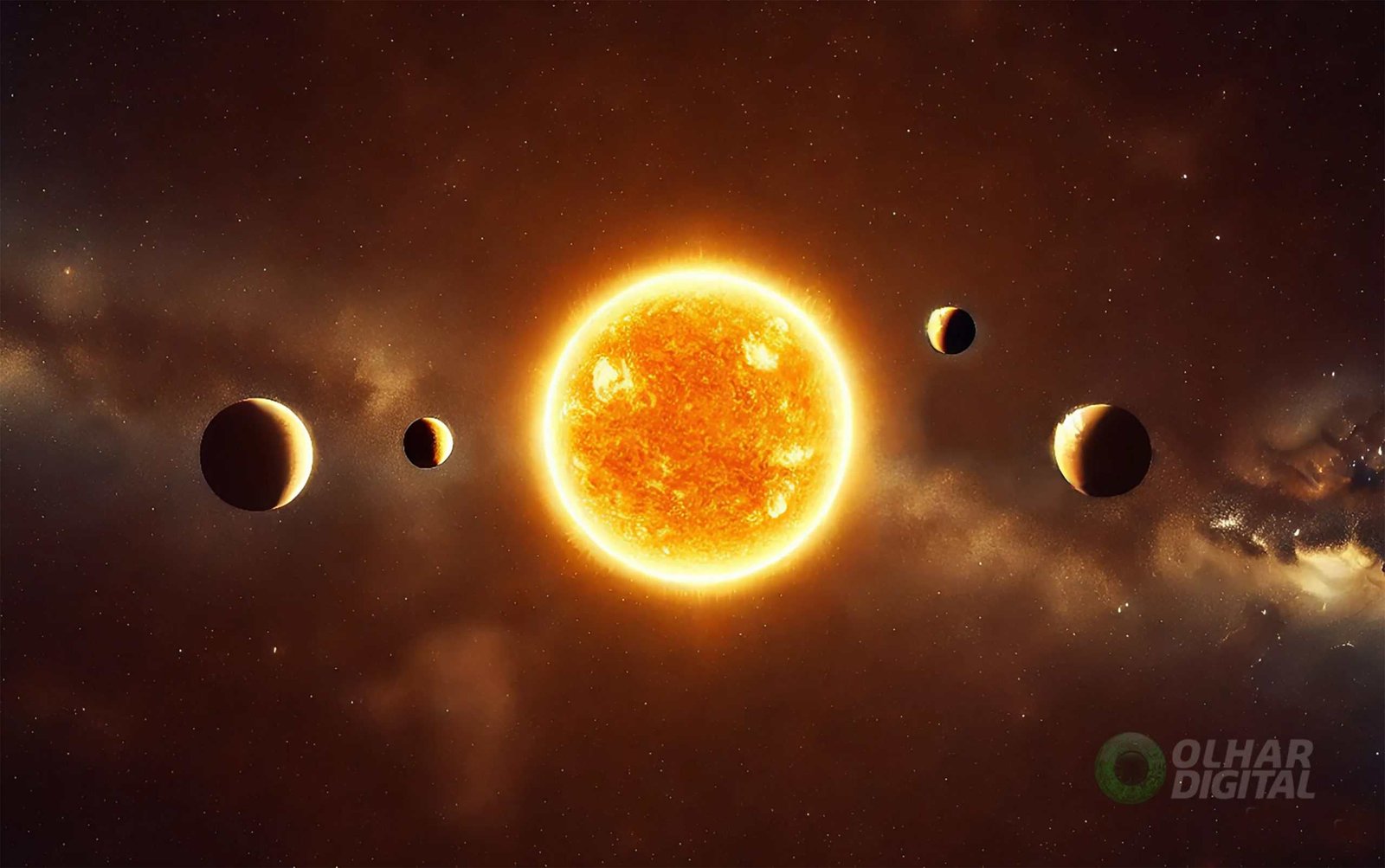
In October last year, the Digital appearance He reported the discovery of a “mini-land” around the lonely star closest to the solar system. Now astronomers have just confirmed that this world, called Barnard B, has three more small neighbors: Barnard C, Barnard de Barnard and.
Located only 6 light years from Earth, Barnard’s star is not the closest to the American, this title belongs to the Alpha Centauri system, which includes Next Centauri. The difference is that it is a single star, while Alpha Centauri is a multiple system.
Astronomers have been looking for planets for years around the Barnard star, as red dwarves like her are the most common stars in the Milky Way. In addition, small rock planets are easier to detect these stars, as their weak light makes gravitational oscillations more notable.
However, this red dwarf has less heavy elements than the Sun, which can make it difficult to shape rocky forms. It is also lower and colder, with a surface temperature of 2,800 ° C, while the Sun reaches 5,600 ° C.
The planets were not detected using a traditional method
There are very few planets smaller than the Earth, which makes this discovery around the Barnard star rare. The small worlds detected complete their extremely fast orbits: the closest takes only 2.3 days, while the furthest needs 6.7 days. Due to the proximity to the host star, they are too hot to house liquid water.
The minimum masses of the planets range from 20% to 34% of the Earth’s mass, between double and triple of the mass of Mars. Analyzes indicate that planets greater than 57% of the Earth’s mass do not exist in the habitable area of the star. This reduces the possibilities that any of these worlds have adequate conditions for life.

“It is a really exciting discovery: Barnard’s star is our cosmic neighbor, and we still know very little,” said Ritvik Basant, a researcher at the University of Chicago and the main author of the study in a statement. For him, this discovery shows the advancement of new generations of astronomical instruments.
Astronomers did not detect these worlds by the traditional method of traffic, which occurs when one of them goes before the star and blocks part of the light. Instead, its presence was identified by analyzing small stars oscillations caused by gravitational attraction. The farthest planet is the smallest ever with this technique.
Read -Ne More:
Advanced instruments confirm “mini-terres” in Barnard Star’s orbit
The confirmation of these planets was a challenge. During the last century, several studies have suggested that the Barnard star could have planets, but evidence was not conclusive. Now, with advanced instruments such as Maro-X on the Gemini Norte telescope in Hawaii, and Espresso, on the very large telescope (BLT), in Chile, it was possible to prove their existence.
“We have observed at different times of the night, without coordination between our teams in Chile and Hawaii,” he said. “This gives us confidence that these signs are not just data noise.”
The study’s results were described in an article published this month in the scientific journal The letters of the Astrophysical Magazine.