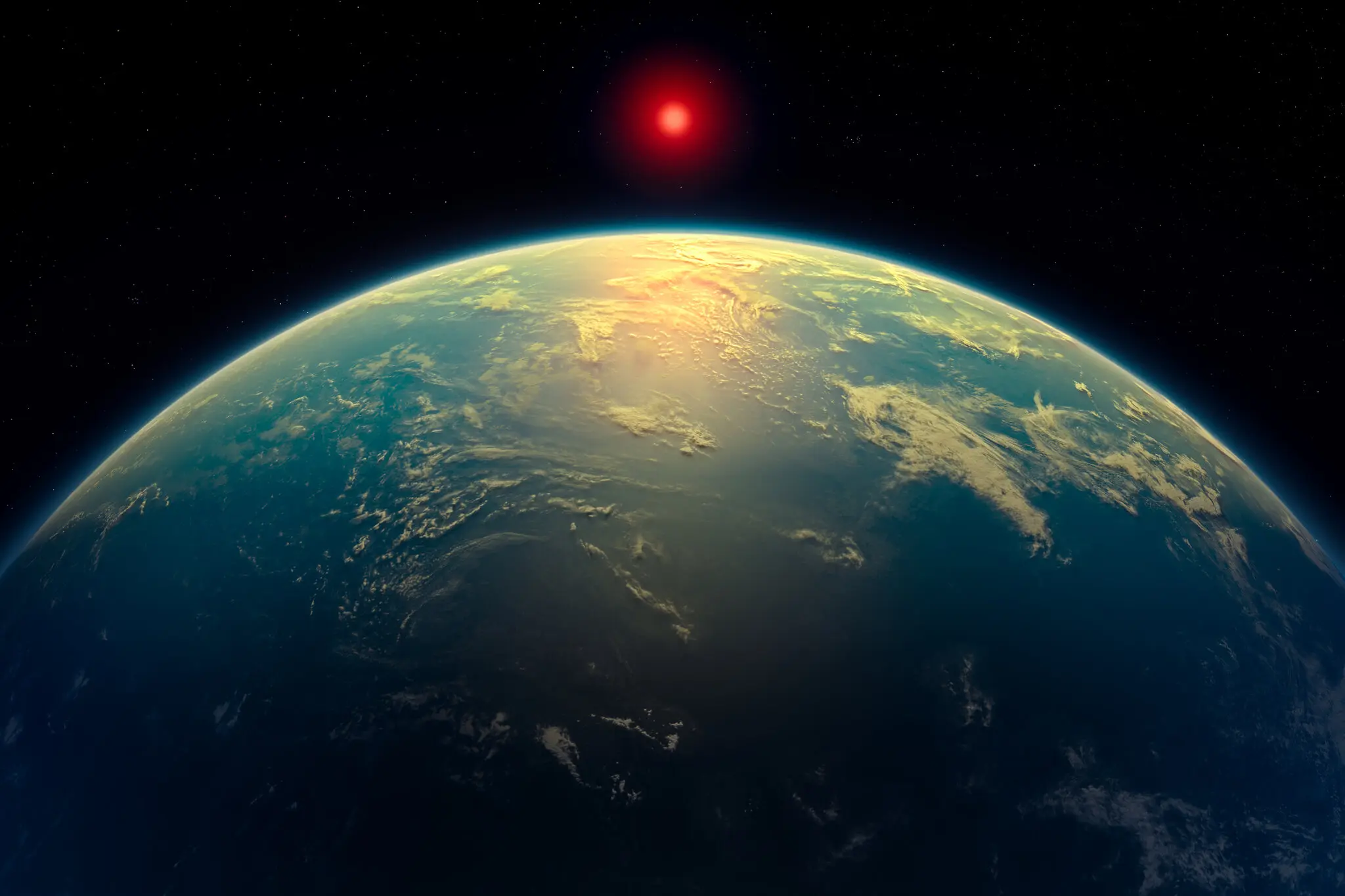
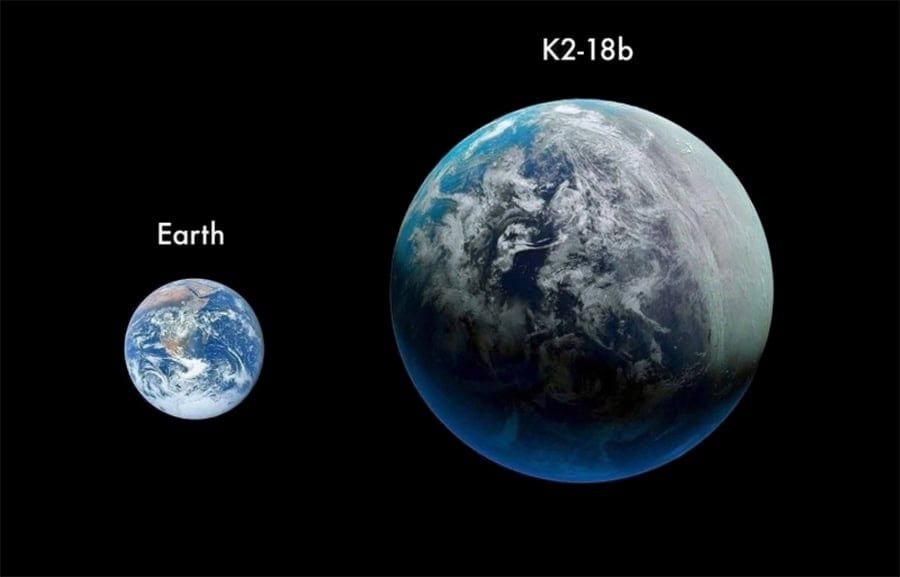
Remember the K2-18B? Ocean Exoplanet discovered in April this year, which had alien life tests? After a bucket of cold water in May, a new research reinforces the idea that extraterrestrial life forms on the planet was only an illusion.
NASA’s new observations confirm that K2-18B, at 124 light years from Earth, has water and possibly in a liquid ocean. This should be a good sign for the existence of life, right? It turns out that it is not.
Can the planet have alien life?
In the April study, conducted by the University of Cambridge, K2-18B seemed to have a gas in its atmosphere, which, on Earth, is only produced by living things. However, the new observations could not find evidence of this gas.
NASA goes further and states that if this gas really exists on the planet, it may have arisen by chemical processes, which controls the possibility of K2-18B.
This shows how difficult it is to study so far away planets. Although you can see a neighbor like Jupiter from Earth, planets like K2-18B are invisible even to ordinary telescopes, due to their distance and the absence of its own light.
To overcome this difficulty, astronomers use advanced methods. It involves observing the moment when the planet passes in front of its star. Starlight crosses the planet’s atmosphere, identifying which gases are. This technique had already been successfully used on the GJ 1214b planet, revealing water vapor in its atmosphere.
With the launch of the James Webb Space Telescope of NASA in 2021, scientists obtained an even more accurate tool. It is able to detect subtle variations in infrared light, which helps to identify gas even in extremely distant atmospheres. And it was precisely with this observatory that scientists began to investigate the K2-18B more carefully.
In 2023, astronomer Nikku Madhusudhan and his team pointed to the K2-18B telescope. They detected hydrogen, carbon dioxide and methane in their atmosphere. They also found a possible signature of Sulfur Dimethy (DMS), a gas related to Gas on Earth. But the signal was too weak to confirm your presence safely.
The following year, the team decided to make a new observation, now with another instrument of the telescope, aimed at the infrared light of the largest wavelengths. This time, the presence of the dimethyl sulfide seemed stronger. According to the article describing the results, there were only three possibilities in a thousand signal that was the result of chance, which encouraged researchers.
No encouragement results were confirmed
According to the newspaper The New York Times (NYT), although Madhusudhan is recognized as one of the main experts on the planet outside the solar system, other astronomers have decided to check the data alone. A team led by Rafael Luque, from the University of Chicago, for example, combined all the available K2-18B available observations and did not find reliable signs of this gas, according to the study article.
Read -Ne More:
Critics argue that the average infrared light, used in the second analysis, can be very weak and confuse the instruments. The new study directed by Renyu Hu from NASA’s propulsion laboratory, concludes that the new world is “quite rich in water”. However, if you wait for the alien life, you will disappoint you.
“Our article does not provide any conclusive proof of the existence of DMS,” said Dr. Hu. “We don’t believe we have a detection,” Hu said The New York Times.
It is still possible that the K2-18B contains some DM, but at a very low level that is clearly detected. And even if the item is there, it is not life yet. That is, a change is required for the first evidence on the confirmed exoplanet.