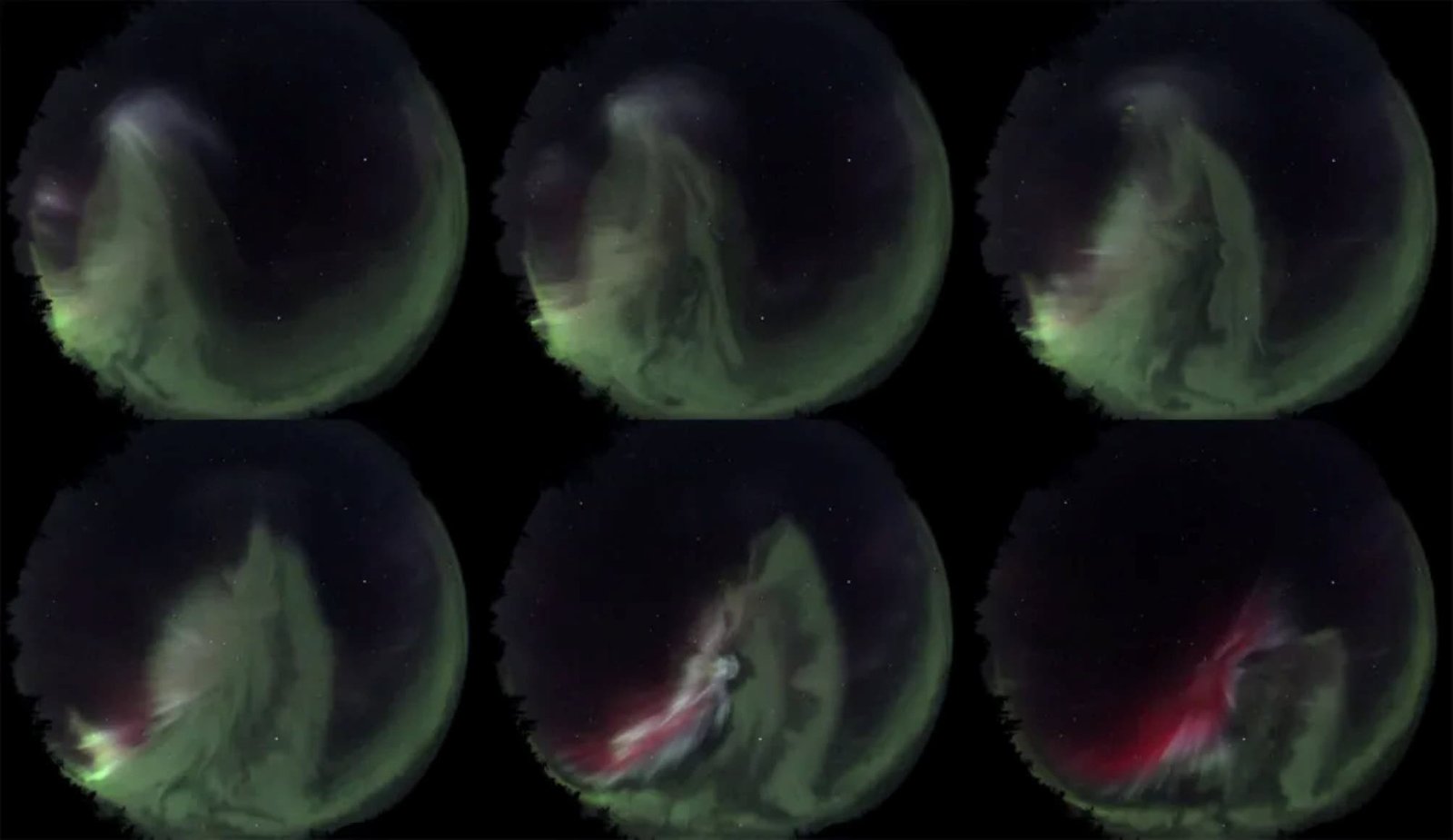
The researchers saw white “tapes” intertwined through Alba Boreal. The new images reveal that these sparks may appear next to the red and green golden, the most common.
However, these calories are not like other boreal and Australian phenomena. Scientists report, in a new article in Nature Communications, that illuminated rays may arise through a process similar to the lilac brightness called Steve, another case that intrigues researchers in the area.
A strange white band found in Aurora
The Calgary University team in Canada, for the first time, noticed something strange in the Aurora Bolral through special photos. In the Explorer Mission of the Transition Region, or Trex, a network of low light cameras and other teams are engaged in the detection of the space environment near the Earth.
While other tools for capturing auroral images only collect red light and green lengths, the trex cameras generate colored images. This allows the group to see in addition to the bright spectra already known to scientists.
One day, in 2023, EmmaPanswick space Physics was reviewing some of these photos with a colleague. “We saw something very, very strange. It was a kind of gray and white place,” he tells Space News. “We both thought,” What is this? “”

After seeing the whitish lanes in other pictures, he contacted the team to do a wider search using previous trex data. They found 30 Dawn White on Rabbit Lake and Lucky Lake, in the state of Saskatchewan, from 2019 to 2023.
Images from all over the sky showed that white markings can be hundreds of kilometers. Sometimes they appeared next to the red or green auroras. Other times, white light flourished in places where the dawn had just disappeared.
The spectral data collected by the team confirmed that the whitish light is made up of continuous emissions. “When you see a continuous emission, you have a little light on all wavelengths,” says Spanishwick.
This training is different from normal auroras. In the already known phenomenon, the “rain” particles in the atmosphere and excite the atoms to emit red and green wavelengths.

The continuous emission of the white boreal aurora is very much like that of Steve Lights, a shortage of high thermal emission speed. It is a purple track that extends from east to west in the sky in the regions closest to the equator than the typical auroras.
Researchers believe that this phenomenon comes from an extremely fast plasma river that crosses the atmosphere, warming the particles to shine. New white lights may also arise from atmospheric warming, proposing the team.

Read -Ne More:
“But what is causing warming? And why in this place and not in the nearby region?” Spanswick says. “We have no idea.”
The irregularity of the north white lights, compared to the Sharp Arch of Steve, suggests that the two phenomena are not exactly the same, according to the scientist. However, there may be a chemistry similar to both of them, which would help solve the mystery.
It is not yet clear how the Plasma stream alters substances to the atmosphere to create Steve, much less the new white light. Investigate other similar emissions hiding among auroras, say scientists, “could provide valuable clues.”